International Feature: Idrissa Nonmon Sanogo
Friday, February, 27th, 2026 News and Updates Student Spotlight
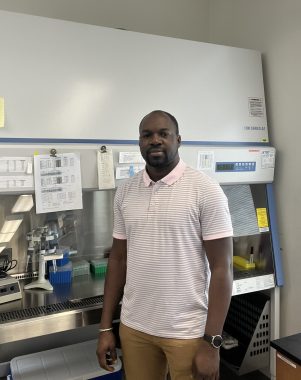
For the next installment of our International Community Feature, it’s a delight to spotlight Idrissa Nonmon Sanogo, an Infectious Disease and Global Health Postdoctoral Fellow at the Cummings School of Veterinary Medicine at Tufts University.
Idrissa’s international journey leading to Tufts has taken many turns. He got his start growing up in Bamako, Mali speaking both Bambara and French. With an early interest in biological sciences, his sights were set on going into Medicine. When he received a scholarship to study at Ibn Khaldun University of Tiaret in Algeria, he ended up in their Veterinary program somewhat by accident but ultimately grew to love the field. Upon graduating with his DVM, Idrissa returned to Mali to work in food safety and Veterinary Public health with the government for two years. He then received another scholarship to pursue a Master’s Degree in Integrated Management of Health Risk in the Global South at the University of Liège in Belgium. After completing this degree, he once again returned to Mali as a Teaching and Research Assistant at the Université de Ségou. PhD studies began calling and he next went to the National Polytechnic Institute of Toulouse in France, where he focused on influenza viruses in Africa as part of the department of Infectiology, Pathophysiology, Toxicology, Genetics, and Nutrition. As part of this research, he had the opportunity to collaborate with many labs in West and East Africa.
Until this point, Idrissa had been immersed in francophone settings, but he soon realized a growing desire to shift to an anglophone environment which would be critical for expanding his professional network and broadening the scope of his publications. Also, after collaborating with the Webby lab in St. Jude Children’s Research Hospital in Memphis, TN during his PhD work, he started to get a better sense of the wealth of resources American labs offered and the diverse mix of cultures in the US felt appealing to him. The Cummings School came onto his radar because his PhD advisor in Toulouse was a member of the same NIH Centers of Excellence for Influenza Research and Response network as the Tufts Runstadler Lab (directed by Dr. Jonathan Runstadler, who is Idrissa’s current advisor).
Since coming to Tufts, Idrissa’s research has focused on avian influenza and SARS-CoV-2 in wildlife. For the latter, he sought to determine whether the virus that causes COVID-19 was being transferred from humans to wildlife and if so, what the implications of that could be. About 4,000 swab and blood samples from various terrestrial wildlife and marine mammals were collected and tested – white-tailed deer stood out as being one of the most affected, and evidence of past exposure was also detected in three marine mammal species. After his postdoc, Idrissa hopes to establish an independent research project on respiratory viruses, with an emphasis on understanding viral diversity and evolution. Improving disease detection is also a particular area of focus and he is currently working on developing invitro airway cell culture models from selected wildlife species.
Though not without its adjustments, studying on the North Grafton campus and living in Worcester have been positive and rewarding for Idrissa. He speaks with fondness about the natural beauty of the rural landscape surrounding campus. He was without a car and was fairly limited in being able to explore when he first arrived but now he very much enjoys road-tripping around Massachusetts and the US with his wife and three children – they recently just drove to Washington, DC stopping in Philadelphia and Baltimore en route. When it comes to social interactions in the workplace, he noted that in France during his PhD he experienced much more group discussion and communal activities as opposed to here where things feel largely more individual and independent. To aid in this adjustment, he’s made an effort to get together with his colleagues and build community by organizing group outings – for instance to the Big E agricultural fair in Springfield this past fall. And when it comes to managing homesickness, he maintains frequent contact with friends and family in Mali and tries to seek out touches of home here. Though there isn’t a large Malian community in Worcester, he does gather to share meals and celebrate holidays with a few who reside in the area. And as it would happen, last year Worcester held their bi-annual Malian Festival where he was able to enjoy eating dégué (a traditional dessert made with millet and condensed milk) and hearing the music of the balafon. And he frequents the Danco African Market in Worcester that carries African spices and otherwise hard to find ingredients.
Reflecting on his experience at Tufts and in the US, Idrissa sums it up as deeply enriching. It has broadened his perspective in so many ways and has allowed him to apply his skills in stimulating new contexts. His advice to other international students is to be proactive, ask questions early on, and seek mentorship. It is so important to have support and guidance, as well as to build connections outside of your immediate work and academic settings. The instinct might be to try to navigate things alone in order not to stand out but finding that sense of belonging amongst others here is critical.
–by Julia Keith
(photo courtesy of Idrissa Nonmon Sanogo)